What is OSINT

OSINT (Open-Source Intelligence) is the process of collecting and analyzing publicly available info using advanced technologies like big data and AI, combined with expert analysis, to generate actionable intelligence on specific targets.

Unlike traditional intelligence methods, OSINT relies exclusively on public, legally accessible data—no hacking, unauthorized access, or invasive techniques are used. It transforms raw public data into structured, actionable insights that drive critical decisions for law enforcement, financial institutions, and enterprises.
thumb

OSINT Principles, Tools and Techniques

The core principle of OSINT is to collect and analyze data that is freely available to the public, without resorting to covert or classified sources.

OSINT techniques are the methods used to collect, analyze, and interpret open–source intelligence—information that’s publicly available and legally accessible—to produce actionable intelligence. These techniques are used to collect, verify, and synthesize data from open sources such as:

  • Websites and blogs
  • Social media platforms
  • Online forums and communities
  • News articles and press releases
  • Public government databases
  • Domain records and WHOIS data
  • Multimedia (images, videos, metadata)
  • Gray literature
  • Dark web
  • Breach data
  • Geolocation data
  • Commercially available information (satellite imagery, marketing data, etc.)

OSINT Features

Multi-Source Data Collection

Gathers from social media, news, public records, dark web, and forums to build a complete data picture.

Social Media Monitoring
Advanced Analysis Tools

Supports email/IP/domain search, link analysis, geolocation, and metadata analysis for deep insights.

Actionable Intelligence Output

Delivers real-time, verified insights for risk assessment, fraud detection, and threat mitigation.

Ethical & Non-Intrusive

Passive data collection only, fully compliant with global legal and ethical standards.

Core Principles & Characteristics

To better understand how OSINT techniques work in practice, it is essential to identify the key characteristics that define them. These attributes not only differentiate OSINT from other intelligence gathering methods but also underscore its distinctive strengths and limitations.

Legality & Ethics

Relies strictly on public, accessible information, avoiding hacking or unauthorized access, ensuring it ethical and compliant.

Non-Intrusive

Primarily passive data collection, focusing on what's already public, though active methods (e.g., DNS queries) exist.

Diverse Sources

Gathers from websites, social media, news, outlets records, forums, and more to build a complete picture.

Actionable Insights

Transforms raw data into useful intelligence for decision-making.

Cost-Effective

Often cheaper than traditional intelligence gathering as it uses free/public resources.

Verification & Cross-Referencing

Confirms findings using multiple independent sources.

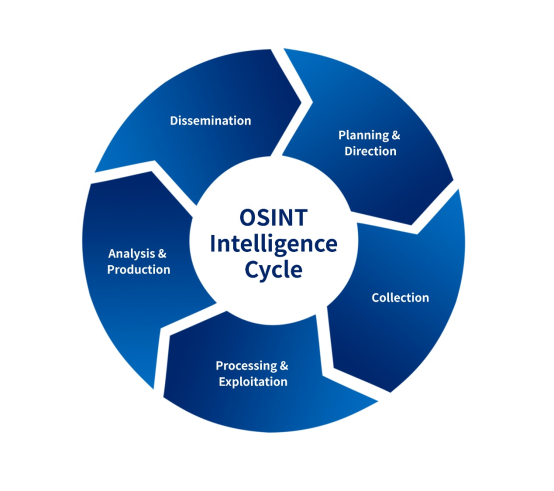
OSINT Intelligence Cycle

OSINT is a multi-methods methodology for collecting, analyzing, and making decisions about data accessible in the public domain. OSINT operations use cutting-edge tools to sift through a sizable haystack of visible data for the needles they need to accomplish their goals and uncover information that many people are unaware is public. The intelligence cycle is the process that many government and commercial organizations use to organize their workflows when conducting intelligence activities.

  • Planning & Direction: Define requirements, sources, and goals.
  • Collection: Gather data from public online assets (news, social, blogs).
  • Processing & Exploitation: Translate, transcribe, and validate data; organize into centralized repositories.
  • Analysis & Production: Verify authenticity, cross-reference, and extract actionable insights.
  • Dissemination: Deliver reports/briefings; collect feedback for cycle repetition.
OSINT Intelligence Cycle -

AI Capabilities for OSINT Investigation

Automate Routine Parts of Investigation - processing vast datasets based on AI capabilities.

Collect & Process
Data Collection

Using AI technologies to automate collecting and gathering relevant data and information from a wide range of sources. It also brings new capabilities to generate keywords, hashtags, or terms likely to appear in open-source content related to the topic.

Natural Language Processing

NLP capabilities allow AI tools to analyze text data, extracting keywords and entities from large volumes of content and sources.

Multilingual and Multimodal Analysis

AI technology eliminates language barriers by translating and analyzing multiple languages at once. It also processes text, images, audio, and video together for a comprehensive intelligence overview.

Pattern Recognition

AI enables recognizing patterns and trends within data that are not immediately obvious. For example, machine learning algorithms can analyze user behavior on social media platforms to identify potential threats.

Analyze
Data Analysis

Advanced AI tools make it powerful for analysing large sets of data and for detecting patterns and insights in complex datasets.

Predictive Analysis

By analyzing historical data and current trends, AI can help predict future events or behaviors, adding a proactive dimension to OSINT.

Background Research

Using AI technologies (such as integrated ChatGPT) to offer background information on specific topics, individuals, locations, events, etc.

Image and Video Analysis

AI capabilities to process visual data to extract insights. Tools like facial recognition systems and lip-reading technologies can enhance the quality of investigations involving media content.

Anomaly Detection

AI flag unusual patterns that need in-depth investigation by learning what constitutes normal behavior in various contexts.

Want to see how OSINT solves real-world challenges?

Explore OSINT Case Studies